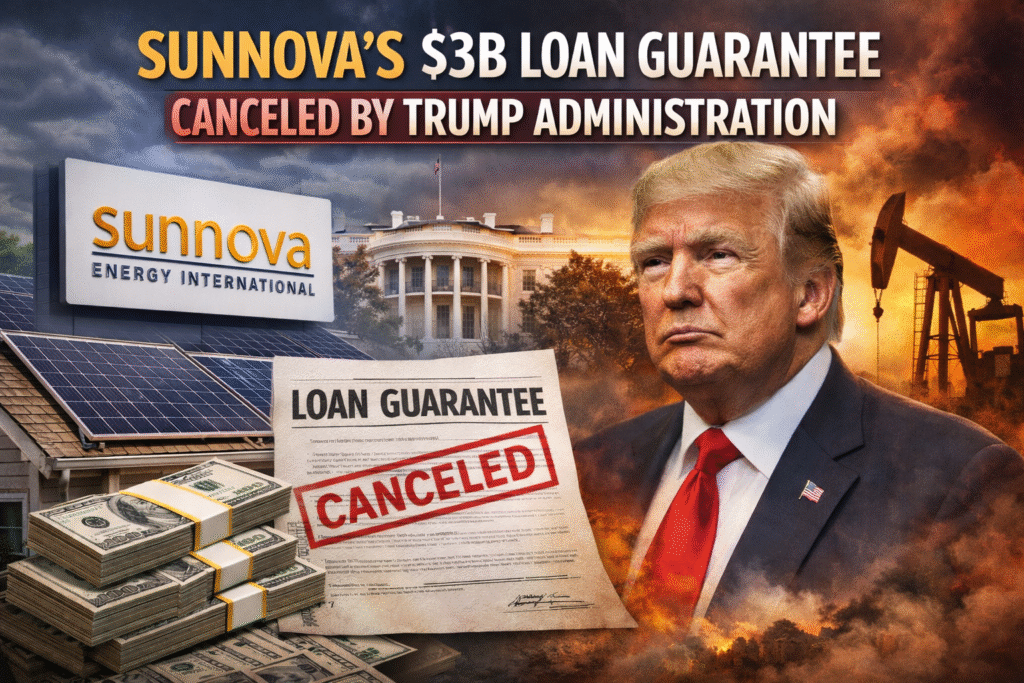

A significant step in the development of the U.S. renewable energy industry occurred when the Trump administration rescinded a government guarantee of a loan totalling almost $3 billion that was to be given to Sunnova Energy International, a solar company. The ruling has created controversy on the future of solar energy funding, the role of the government in clean energy, and the financial viability of the residential solar firms.
This paper discusses what the loan guarantee was, why it was canceled and what it may entail in the future of the solar industry in the United States.
The history of the $3 Billion Loan Guarantee goes back to 1939
In 2023, the U.S. Department of Energy under the leadership of Joe Biden gave Sunnova a **partial loan of approximately 2.92 billion dollars guarantee loan. The program focused on funding approximately 100,000 rooftop solar systems, particularly those of the low-income families located around the United States. ([Reuters][1])
The program was included in a larger program to increase the clean energy infrastructure and cut greenhouse gas emissions. It was also deemed to be the largest federal funding of residential solar power back in the day. ([Reuters][1])
It was a program called, Hestia, which is a type of funds that were to assist homeowners to get solar power cheaply with the aid of government financing.
The Trump Administration rescinded the Loan because of this reason
In May 2025, the administration of Donald Trump cancelled the loan guarantee after Sunnova advised federal authorities that it was not planning to spend the remaining money. ([Bloomberg Law][2])
The decision was caused by a number of factors:
1. Changing Business Model at Sunnova.
Sunnova changed their business model to no longer focus on loan-based solar funding and instead move to leasing and power purchase agreements, which were deemed more lucrative because of the federal tax credits.
2. High Interest Rates
The residential solar market was subjected to financial pressure by the increasing interests rates which raised the cost of borrowing by the companies and customers.
3. The Solar Market has a weak demand.
- In important markets like California, solar on residential homes reduced its demand following a cut in some state incentives.
- The Trump government indicated a change in policy to increase the production of fossil fuel and examine subsidies on renewable energy initiatives. ([Investing.com India][3])
4. Government Policy Changes
Since Sunnova was no longer intending to use the loan facility, the Department of Energy formally gave the guarantee the status of being de-obligated, or in other words, the government no longer had a duty to support the funding. ([Reuters][1])
How Much of the Loan Was Used?
By the time the cancellation occurred, Sunnova had already drawn out of the loan guarantee approximately the sum of money of $371 million, which it used to finance installations of solar. ([Investing.com India][3])
The rest of the money, more than entities of 2.5 billion dollars, were never used following the decision to explore other sources of finance by the company.
Impact on the Solar Industry
The cancellation was a cause of concern over the sustainability of government contribution to renewable energy projects.
Alternate reasons are insufficient confidence in solar financing.
The guaranteed schemes provided by government usually assist the companies in obtaining the private funds. Their elimination can result in a more challenging process of financing solar companies.
The pressure placed on Residential Solar Companies is an additional element that has greatly aided in improving the effectiveness of the business model.
Solar residential projects by many companies such as Sunnova have not been successful because of the high cost of financing and fluctuating government incentives.
Policy Uncertainty
The changing of policies every new administration tends to bring confusion to investors and energy organizations intending to do long term projects.
As a relatively new company, Sunnava faces financial challenges.
Sunnova was already struggling with financial problems at the time of the cancellation. It was reported that the company was reorganising its debt and was looking at bankruptcy protection as a result of the increasing expenses and the decreasing demand in the solar market. ([Investing.com India][3])
Also, deeper operational issues in the company were indicated by leadership changes and layoffs.
This implication on the future of solar energy.
The issue of Sunnova having its loan guarantee canceled shows the political and financial risks involved in the renewable energy industry. Although the development of solar power is increasing all over the world, companies tend to rely on the supportive policies, incentives, and financing programs.
Residential solar in the U.S. is likely to be reliant on the following in the long-term:
- Stable government policies
- Lower financing costs
- Solar and battery storage technological advancements.
- Ongoing demand by homeowners of clean energy solutions.
Conclusion
The fact that the Trump administration cancelled the $3 billion loan guarantee of Sunnova is a major breakthrough in the U.S. solar industry. Although this move was, in part, caused by the change in strategy of Sunnova, it represents a larger political and economic problem of renewable energy.
This means that the growth rate of solar energy in the future will depend on the balance between the support of the government, personal investments, and the market demand as the global energy transition continues to happen.